

 中文简体
 عربى

ZHONGSHENG
ZHONGSHENG
ZHONGSHENG
ZHONGSHENG
ZHONGSHENG
ZHONGSHENG
ZHONGSHENG
ZHONGSHENG
ZHONGSHENG
Corrosion on an appliance PCB needs only three things: moisture, ionic contamination and electrical bias. Remove or block any one of them and the damage slows sharply. Light surface corrosion can often be cleaned with high-purity isopropyl alcohol and a soft brush, then dried fully. Once copper traces are eaten through, or green deposits sit under components, repair is rarely reliable and board replacement is the safer choice. Long-term protection comes from design choices: a suitable surface finish, a clean assembly process, conformal coating and a layout that keeps water away from the board.
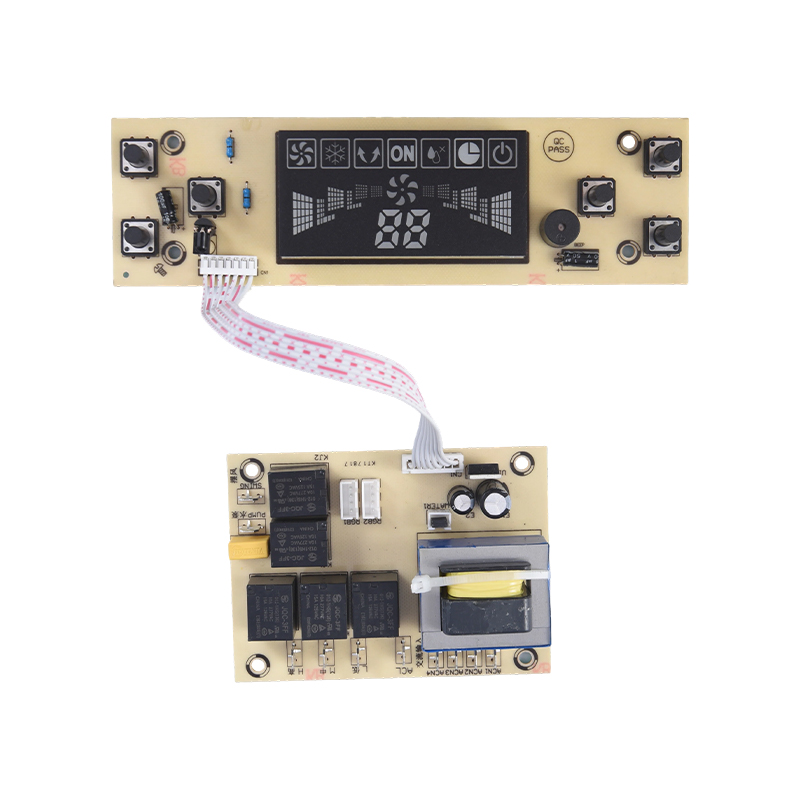
Evaporative coolers are a harder case than most appliances because the control board sits close to a water tank, a pump and a constant stream of humid air. An Evaporative Air Cooler PCB that is built and protected for this environment will last far longer than a general-purpose board. The sections below explain why corrosion starts, how to recognise it, how to clean it, and what to specify when you want a board that resists it.
Content
- 1 What causes corrosion on appliance circuit boards
- 2 How to recognise corrosion before the board fails
- 3 How to clean a corroded PCB safely
- 4 Why evaporative coolers are tough on circuit boards
- 5 Protection methods compared
- 6 Tests that prove a board can survive humidity
- 7 What to ask for when buying an evaporative cooler control board
- 8 Simple habits that reduce corrosion in the field
- 9 Frequently asked questions
What causes corrosion on appliance circuit boards
Corrosion is an electrochemical process. A thin film of water forms on the board surface, dissolves ionic residues and turns the surface into a weak electrolyte. Current can then flow between traces that should be isolated, and metal dissolves at the positive side. Several factors feed this process.
Humidity and condensation
Salts left on a board absorb water from the air once the humidity passes a critical point. For sodium chloride, that point is about 75 percent relative humidity at 25 degrees Celsius (Source: Greenspan, L., Humidity Fixed Points of Binary Saturated Aqueous Solutions, Journal of Research of the National Bureau of Standards, 1977). In an evaporative cooler, air near the pad and the water tank is often above that level, so contaminated boards can stay wet for hours each day. Condensation is even worse, because it can happen when a cool board is exposed to warm, moist air.
Ionic residue from manufacturing and handling
Flux residue, fingerprints, cleaning agents and plating salts all leave ions behind. Chloride and weak organic acids are the most damaging. A traditional benchmark for ionic cleanliness is about 1.56 micrograms of sodium chloride equivalent per square centimeter, which was used in older IPC and military specifications. Modern practice is to set limits by risk, using ion chromatography (IPC-TM-650, Method 2.3.28) to see which ions are present, because a low total number can still hide a harmful ion.
Hard water, scale and splash
Water in coolers carries dissolved minerals. The U.S. Geological Survey classes water above 120 milligrams per liter as calcium carbonate as hard, and above 180 milligrams per liter as very hard. When splashes or mist reach a board, the minerals dry into conductive crusts that hold moisture. Algae and biofilm in the tank add organic acids and keep surfaces wet.
Corrosive gases and coastal air
Sulfur compounds attack silver and copper, while salt-laden coastal air adds chloride. The ISA 71.04 standard classes environments by the thickness of corrosion that forms on a copper test coupon in 30 days. Class G1 is below 300 angstroms, G2 is below 1000, G3 is below 2000 and class GX is 2000 or more (Source: ANSI/ISA-71.04, Environmental Conditions for Process Measurement and Control Systems: Airborne Contaminants).
Electrical bias and electrochemical migration
When a wet, contaminated gap sits between two traces at different voltages, metal ions can move across the gap and grow thin dendrites. These can short the traces and cause intermittent faults that disappear when the board dries. This effect is the reason a corroded board may work in the morning and fail on humid afternoons.
How to recognise corrosion before the board fails
Early signs are easier to deal with than late ones. Inspect with good light and a magnifier, and photograph the board before touching it so you can compare later.
| What you see | Likely cause | What to do |
|---|---|---|
| Green or blue-green deposits on copper pads or pins | Copper corrosion from moisture and chloride | Clean gently; inspect for lifted pads and thinned traces |
| White or gray powder on solder or connector legs | Tin or aluminum corrosion, often with scale | Brush off, clean and check joint integrity |
| Black or brown tarnish on silver or contacts | Sulfur attack | Replace contacts if resistance has risen |
| White crust or hard scale around the board edge | Mineral deposits from hard water splash | Remove with a soft brush and deionized water, then find the leak path |
| Brown stain around capacitor base | Electrolyte leakage, often mistaken for corrosion | Replace the capacitor and clean the residue, which is corrosive |
| Intermittent faults on humid days | Leakage or dendrites between traces | Clean and dry the board; if faults return, replace it |
How to clean a corroded PCB safely
Cleaning is worth trying when corrosion is superficial and no traces are broken. Work on a grounded, well-lit bench. Isopropyl alcohol is flammable, so keep it away from heat sources and ventilate the area.
- Unplug the appliance and wait for the power capacitors to discharge before touching the board.
- Photograph the board and connector positions, then remove the board and disconnect harnesses.
- Brush away loose dust and scale with a dry, soft anti-static brush.
- Apply isopropyl alcohol of 90 percent or higher to the affected areas and scrub lightly with a soft brush, working away from components.
- For stubborn ionic residue, rinse with deionized water, because tap water leaves new minerals behind.
- Dry completely. Typical workshop practice is air drying followed by a gentle warm bake of about 50 to 60 degrees Celsius for one to two hours.
- Inspect under magnification, measure resistance on suspect traces and replace damaged parts.
- Refit the board only after the leak or splash path has been fixed.
What not to do
- Do not use vinegar, baking soda or household cleaners, because they leave ionic residue.
- Do not use abrasive pads or scrape with metal tools, which can cut thin traces and solder mask.
- Do not power up a board that is still damp.
- Do not coat a board that has not been cleaned, because coating over residue traps ions against the surface.
Why evaporative coolers are tough on circuit boards
An evaporative cooler works by moving air across a wet pad, so high humidity is part of normal operation. The control board typically manages the fan motor, the water pump and the speed or mode settings, and it often sits near the tank or in the airflow path. Several things add to the risk:
- Splashes and mist when the tank is filled or the unit is moved.
- Scale from mineral-rich water drying on nearby surfaces.
- Seasonal storage in damp garages or balconies, where condensation forms on cold boards.
- Dust that mixes with moisture and forms a conductive film on the board.
- Water pump and motor connectors that carry current in a damp place.
For these reasons, an Evaporative Air Cooler PCB should be judged on its humidity resistance as much as on its functions. A board designed for a dry control cabinet can fail in a single season when installed in a cooler.
Protection methods compared
No single measure covers every risk, so most reliable products combine several. The table summarizes the common options.
| Method | How it helps | Points to watch |
|---|---|---|
| Conformal coating (acrylic, silicone, polyurethane, epoxy, parylene) | Forms a moisture and contamination barrier over the board | Must be applied on a clean board; connectors and test points need masking |
| Potting | Seals the board in resin for splash and immersion risk | Harder to repair; heat dissipation must be planned |
| Corrosion-resistant surface finish such as ENIG | Protects exposed copper pads better than bare copper or OSP in humid air | Higher cost; plating quality matters |
| Clean assembly with controlled flux residue | Removes the ions that drive corrosion | Needs process control and cleanliness testing |
| Wider spacing and slots between high-voltage traces | Reduces leakage and migration risk | Uses board area; follow creepage rules |
| Sealed enclosure, gaskets and drip paths | Keeps water and mist off the board | Needs good fit and tested ingress protection |
Conformal coating thickness
IPC-A-610 gives typical coating thickness ranges by type: about 0.03 to 0.13 millimeters for acrylic, epoxy and polyurethane, 0.05 to 0.21 millimeters for silicone, and 0.01 to 0.05 millimeters for parylene. Coatings that are too thin leave pinholes, while coatings that are too thick can crack during temperature cycling. Qualification of coating materials follows IPC-CC-830. Source: IPC-A-610, Acceptability of Electronic Assemblies, and IPC-CC-830, Qualification and Performance of Electrical Insulating Compound for Printed Wiring Assemblies.
Board layout and creepage
Spacing between conductors depends on the voltage and the pollution degree defined in IEC 60664-1. Pollution degree 3 applies where conductive pollution or condensation is expected, and it requires larger clearances and creepage distances than pollution degree 2. Household appliance safety requirements are covered in IEC 60335-1. A board used in a humid cooler should be reviewed against the more demanding pollution degree, not the mildest one.
Tests that prove a board can survive humidity
Claims about moisture resistance mean little without test data. Ask for results from standard tests, and check the conditions used.
| Test | Standard | What it shows |
|---|---|---|
| Damp heat, steady state (for example 40 degrees Celsius, 93 percent relative humidity) | IEC 60068-2-78 | Long-term resistance to high humidity |
| Damp heat, cyclic | IEC 60068-2-30 | Behavior with condensation as temperature cycles |
| Temperature humidity bias (85 degrees Celsius, 85 percent relative humidity) | JEDEC JESD22-A101 | Leakage and migration under voltage |
| Surface insulation resistance | IPC-TM-650, Method 2.6.3.7 | Whether residues cause leakage between traces |
| Salt mist | IEC 60068-2-11 | Resistance in coastal or salty air |
| Mixed flowing gas | IEC 60068-2-60 | Resistance to sulfur and other corrosive gases |
Source: the standards named in the table. For a cooler used in a normal home, damp heat and surface insulation resistance results give the most useful picture, while salt mist tests matter most for coastal markets.
What to ask for when buying an evaporative cooler control board
If you are an appliance maker or a service buyer, a short checklist can prevent costly returns. When you review an Evaporative Air Cooler PCB, confirm these points with the supplier:
- Which surface finish is used on pads and connector fingers.
- Whether the board is coated or potted, with which material and what thickness.
- How the board is cleaned after soldering and whether ionic cleanliness is tested.
- What humidity or damp heat testing the design has passed, and under which standard.
- How relays, connectors and high-voltage areas are spaced and protected.
- Whether the layout suits your housing, including board height above the water level and drip protection.
Sharing the water quality, the climate and the mounting position of the board with the supplier helps them choose the right protection level for your product.
Simple habits that reduce corrosion in the field
Even a well-built board benefits from good use. These habits are easy to teach to end users and service staff:
- Unplug the cooler before refilling the tank and avoid spilling water near the control panel.
- Descale the tank and pad regularly, especially where water is hard.
- Drain and dry the unit before storing it for the winter, and store it in a dry place.
- Keep vents and the board compartment free of dust.
- Do not switch a cooler on right after it has been moved from a cold place into warm, humid air; let it reach room temperature first.
- Have a technician check the board if the unit shows intermittent faults, a burnt smell or visible deposits.
Frequently asked questions
Can a corroded PCB be repaired?
Light surface corrosion can often be cleaned and the board reused. If traces are thinned or broken, pads have lifted or the corrosion is under components, replacement is the more reliable option.
Is isopropyl alcohol enough to remove corrosion?
It removes flux, dirt and some light residue. For ionic salts, a rinse with deionized water followed by thorough drying is more effective.
Does conformal coating stop corrosion completely?
No. It slows moisture and contamination reaching the board, but coating over dirty surfaces, thin spots or uncoated connectors can still allow failure. Clean assembly and good housing design are needed as well.
Why does a cooler board fail only in humid weather?
Ionic residues and mineral deposits absorb moisture as humidity rises, which creates leakage paths between traces. When the air dries, the paths disappear and the fault seems to vanish.