

 中文简体
 عربى

ZHONGSHENG
ZHONGSHENG
ZHONGSHENG
ZHONGSHENG
ZHONGSHENG
ZHONGSHENG
ZHONGSHENG
ZHONGSHENG
ZHONGSHENG
The average service life of an Evaporative Air Cooler PCB is 5 to 8 years in normal household use. A well-designed board with conformal coating, derated components and a stable power supply can reach 10 years. A poorly protected board in a humid, dusty or hot environment may fail in 2 to 4 years.
These figures are practical estimates based on component rating methods and typical seasonal use, not a guaranteed warranty value. The real number depends on moisture exposure, operating temperature, component quality and how often the cooler runs.
A simple usage calculation shows why the calendar age is misleading. If a cooler runs about 10 hours a day for 4 months a year, that is roughly 1,200 operating hours per year. Over 8 years the board has about 9,600 powered hours, which is well inside the rated life of good capacitors and relays.
Content
- 1 Typical service life by use scenario
- 2 Why evaporative coolers are tough on circuit boards
- 3 Which components fail first
- 4 Design features that extend board life
- 5 Warning signs that the board is near the end of its life
- 6 Practical ways to make the PCB last longer
- 7 Repair or replace the board
- 8 Checklist for choosing a durable board supplier
- 9 Key takeaways
- 10 Sources and references
Typical service life by use scenario
The table below summarizes realistic ranges for a control board that drives the fan motor, water pump, swing motor and display. The ranges are engineering estimates from common reliability practice, so treat them as planning values.
| Use scenario | Typical board life | Main stress factor |
|---|---|---|
| Household, seasonal use, dry climate | 7 to 10 years | Normal component aging |
| Household, humid coastal climate | 4 to 7 years | Moisture and salt corrosion |
| Commercial shop or workshop, daily use | 3 to 6 years | Long running hours and dust |
| Outdoor or semi-open space | 2 to 5 years | Splashing water and temperature swings |
| Boards with conformal coating and derated parts | 8 to 12 years | Low, controlled stress |
Why evaporative coolers are tough on circuit boards
Unlike a dry fan, an evaporative cooler sits next to a water tank, a wet cooling pad and a stream of humid air. That makes the control board one of the most stressed parts of the product.
Humidity is the biggest enemy
Air leaving the cooling pad is close to saturation. Moisture on a bare board lowers surface insulation resistance, encourages copper corrosion and can create leakage paths between neighboring traces. Industry test standards such as IEC 60068-2-78 (damp heat, steady state, commonly run at 40 C and 93 percent relative humidity) exist precisely because humidity is a leading cause of electronic failure.
Heat shortens capacitor life
Capacitor manufacturers state that aluminum electrolytic capacitor life roughly halves for every 10 C rise in temperature, the widely used Arrhenius rule of thumb found in capacitor datasheets and application notes. As a calculation example, a capacitor rated for 5,000 hours at 105 C would be expected to last about 80,000 hours at 65 C, because 105 C minus 65 C is four steps of 10 C and 2 to the power of 4 equals 16. Keeping the board cool inside the housing therefore matters a great deal.
Water, minerals and dust
Hard water leaves mineral scale, and splashes can reach the board if the layout is poor. Dust mixed with moisture forms a conductive film. Both effects speed up corrosion and can cause intermittent faults before a complete failure.
Which components fail first
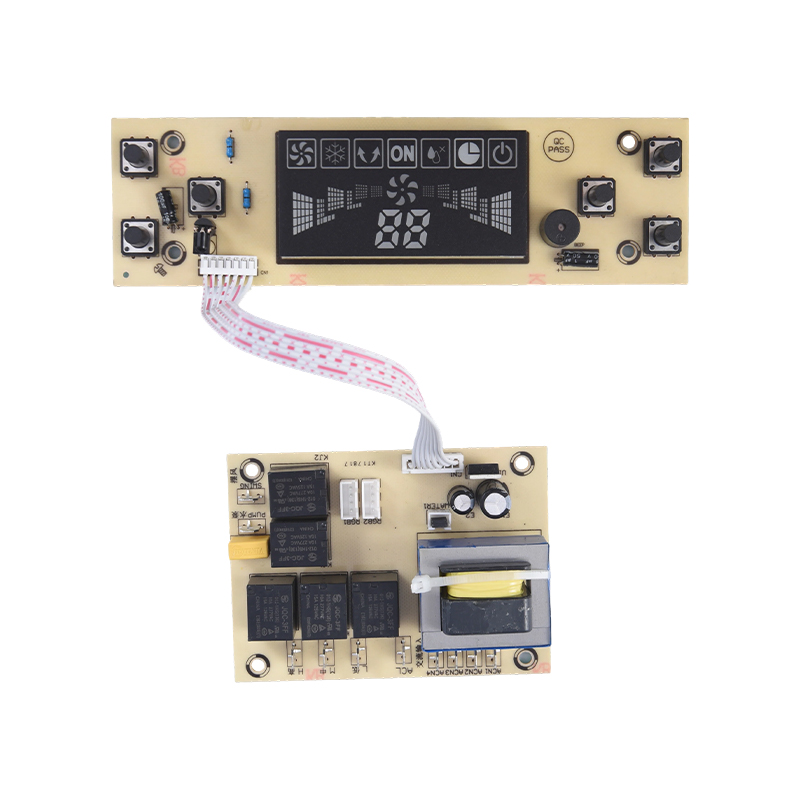
Most board failures trace back to a small group of parts. Knowing them helps with both design and repair decisions.
| Component | Typical failure cause | Common symptom |
|---|---|---|
| Electrolytic capacitors | Heat and electrolyte dry-out | Random resets, unstable fan speed |
| Relays | Contact wear from switching motor loads | Pump or fan will not start |
| Triacs or power switches | Overheating under inductive load | Fan speed stuck on high or off |
| Connectors and terminals | Corrosion and loose contact | Intermittent operation |
| Solder joints on power parts | Thermal cycling fatigue | Cracks, no power or flicker |
| Remote receiver and display | Moisture ingress | Remote ignored, blank display |
Relay datasheets commonly quote mechanical life in the range of millions of operations but electrical life under rated load in the range of tens to hundreds of thousands of operations. Because a cooler switches the pump and motor only a few times a day, relays usually outlast capacitors when the design is sound.
Design features that extend board life
Good manufacturing choices can double the service life compared with a basic board. When we build an Evaporative Air Cooler PCB, these are the points that matter most for long-term reliability.
- Conformal coating applied to the board, following the guidance of IPC-CC-830, to block moisture and dust.
- Capacitors rated for 105 C and operated well below their voltage and temperature limits.
- Relays and power switches sized with a clear margin above the motor and pump current.
- Wide trace spacing and slots between mains and low-voltage areas to reduce leakage risk.
- Surge and overvoltage protection at the mains input.
- Workmanship that meets the acceptance criteria of IPC-A-610 for solder joints and cleanliness.
- Board placement away from the water tank and the humid airflow path.
You can review the available control options on our Evaporative Air Cooler PCB page, including functions such as multi-speed control, timer, swing control and water-level protection.
Warning signs that the board is near the end of its life
Boards rarely die without warning. Watching for early symptoms lets you plan a replacement before the cooler stops completely.
- The cooler restarts or resets by itself during operation.
- Fan speed changes without any button press.
- The remote control works only at very short distance or only sometimes.
- A humming or buzzing sound comes from the board area.
- The display flickers or shows wrong values.
- A burnt smell or brown discoloration appears around components.
- The pump runs when the water tank is empty, which suggests a protection circuit fault.
If you notice a burnt smell or visible damage, unplug the cooler at once. Do not keep running it, because a failed power stage can become a safety risk. Requirements for household appliance safety are covered in the IEC 60335 series, which is the reference for manufacturers.
Practical ways to make the PCB last longer
For users
- Clean the cooling pad and tank regularly so mineral scale does not build up and water does not overflow.
- Use a stable power source and avoid sharing a socket with heavy loads.
- Drain the tank and let the unit dry at the end of the season before storage.
- Keep ventilation slots clear of dust so heat can escape.
For appliance makers
- Run humidity and temperature cycling tests on sample boards before mass production.
- Choose a coating process that fully covers connectors, relays and capacitor leads.
- Use an aging test, for example continuous operation at high ambient temperature, to catch weak boards early.
- Keep a spare parts plan so repair is possible after the warranty ends.
Repair or replace the board
When a cooler is only a few years old, replacing the control board is usually cheaper than buying a new unit. A single failed capacitor or relay can often be repaired by a technician, but repair makes less sense when corrosion has spread across the board or traces are damaged.
| Situation | Better choice |
|---|---|
| One failed relay or capacitor, board otherwise clean | Repair the component |
| Corrosion across several areas | Replace the board |
| Burnt traces or damaged connectors | Replace the board |
| Unit older than 8 years with other worn parts | Consider a new cooler |
When replacing, match the voltage, motor type, pump rating and connector layout. A matched replacement such as our Evaporative Air Cooler PCB keeps the original functions and avoids wiring changes.
Checklist for choosing a durable board supplier
Whether you are an appliance brand or a repair distributor, ask these points before ordering. They tell you more about future service life than a simple price quote.
- Is conformal coating included, and which coating type is used.
- What capacitor temperature rating and rated life are specified.
- Does the supplier run functional testing and aging tests on each batch.
- Which workmanship standard is followed, for example IPC-A-610.
- Can the board be customized for your motor, display and remote control.
- Is there a clear warranty period and technical support after delivery.
At zs-pcba.com, our Evaporative Air Cooler PCB is built with these reliability points in mind, and custom versions can be discussed for your cooler model.
Key takeaways
An evaporative cooler control board normally serves 5 to 8 years, with the upper range of 8 to 12 years possible when moisture protection and component derating are done properly. Heat, humidity and hard water are the three main stress factors, and electrolytic capacitors are the most common first point of failure. Choosing a protected, well-tested board and keeping the cooler clean are the two most effective ways to extend its life.
Sources and references
- IEC 60068-2-78, environmental testing, damp heat, steady state (International Electrotechnical Commission).
- IEC 60335 series, safety of household and similar electrical appliances (International Electrotechnical Commission).
- IPC-CC-830, qualification and performance of electrical insulating compound for printed wiring assemblies (IPC).
- IPC-A-610, acceptability of electronic assemblies (IPC).
- Aluminum electrolytic capacitor application guides and datasheets from capacitor manufacturers, which describe the 10 C halving rule for life expectancy.
- Usage hours and the service life ranges in the tables are our own engineering estimates and calculations, not results of a published study.